If someone ever comes to you, show you some photos they took with some cherry blossom trees in Ueno Koen (Ueno Park), and said they have been to Japan, challenge them further.
Japan is not all about Sakura (cherry blossom), Udon, and Disneyland/Disneysea. Take this blog for an example, I have (tried to) introduce Japan in such a manner that it not only shows it's diverse traditions and culture, but also how those traditions and culture help shape the modern society.
Therefore, in my opinion, tourism has definitely commodified cultures and traditions in Japan.
However, there are ways to stop this vicious cycle. I think that tourists or visitors should be recommended to visit places out of the common. Instead of always going to Disneyland and Universal studio, Fuji Q Highland may be a good place to visit. It is a family theme park over looking Mt Fuji, located beside lake Kawaguchi. Visitors may learn about these amazing sites while they are there.
The tour I went for did me a favor by bringing us to this Thai restaurant. Japan is not all about it's own culture too. Since the country open up to the world, many have visited and stayed in Japan.
This Thai restaurant offers a great variety of Thai food catered to the Japanese and the South East Asian visitors. It was the best meal I had in Japan after six days of Japanese cuisine. Nothing better than taste of home (or nearer to home).
The food is great, trust me on that. It was prepared by Thai people. I have thus decided to go back to Japan for the Thai food. I know, it's ridiculous, but that's how nice the food was.
I am hoping that more people will see the other side of Japan. It is really not all about electronics shopping and fashion clothings. Perhaps a visit to the Ainu village in Hokkaido prefecture will change the whole viewpoint of many people.
The Japanese education system is pretty much similar to that of American's.
A person will have to go through a compulsory three years of pre-schooling, six years of elementary education, and three years each for middle and high school. After which, he/she will either be eligible for University education, Specialized education, or employment. I guess it sounds pretty much like Singapore's education system too, the only difference being the term used and the years spent in each institution.
Other than the system itself, the subjects taught in the compulsory education are subjects like Japanese Language, Mathematics, Science, Social Studies, Art and Craft, Music, etc., which I find similar to that of Singapore too.
However, I once heard from a tour guide in Singapore about her encounter with some Japanese exchange students which caught my attention instantly.
It was a history field trip in secondary school conducted for us to get a better understanding about World War II (WWII). The tour guide told us various information about the war, how many were held prisoners and suffered. We were told that there was once when Japanese students came over to Singapore to get a better understanding about the WWII too. They were taught about the sufferings and torture that the locals had to go through, and could not believe what they heard. they later shared with the tour guide that back in Japan, they were only told about how Singaporeans teamed up with the British and forced them into surrender. The bombing of Hiroshima and Nagasaki were the prove that the Japanese were the ones who suffered from the war.
Well, I guess there are still differences in every education system no matter how similar they look on the outside.
Many people (including myself, before doing this assignment) thinks that Japanese people only speaks Japanese. Period. But when I research on further into the subject, I realized that Japanese people not only speak, well, Japanese. With a total number of 47 prefectures in Japan, they ought to have their on interpretation of the language. Therefore, dialects do exist in the Japanese language.
I can't be talking about all the different dialects in detail with just the length of one simple post, because there is not only 47 dialects, but some cities will have their own dialects too, resulting in a prefecture maybe having more than one or two dialects.
Other than dialects, the Ainu people whom I have mentioned in my post about indigenous people of Japan holds their own language, the Ainu language, too.
Similar to the Chinese, where Mandarin is the common language now, the Tokyo dialect-Japanese (general Japanese language) is the most common language spoken in Japan now. Other than to their own family members, the Japanese do not usually speak dialects. Japanese language schools are also teaching the general Japanese now, therefore, language teachers born and raised in Tokyo are more desirable to these schools.
In the Kansai dialect, instead of "Hontoni?", "Really?" is "Honmani?".
Disneyization, in my opinion, is the result of globalisation.
When everywhere you go, there will be apparels, cafes or shops which are Disney themed, that is Disneyization - bringing Disney to the whole world.
I guess it is pretty easy to spot the Disney in Japan. Tokyo Disneyland is the very first Disneyland in Asia and Tokyo Disneysea is the one and only Disneysea theme park in the world. Although it is named after the capital city of Japan, it is not exactly located there. The theme parks and resorts are actually located in Chiba prefecture, the one beside Tokyo prefecture.
Tokyo Disneyland is always bringing in new ideas of new rides for their guests. This particular Disneyland is said to be the one with the most number of visitors each year. The reason may be because the average number of times a Japanese visits the theme park is four times in their whole life. First, as a child, the parents will bring him/her in. Second, school will organize field trip to the park. Third time will be with their counter-part for a date. The fourth time will be as a parent, bring his/her child in, and the cycle continues. That was only for the locals. With more visitors going into Japan, the theme park ought to earn the most profit as compared to the others in the world.
At the background is the Disneyland Resort.
Cherry Blossoms in Disneyland. Since it was the Cherry Blossom season, the theme park incorporated such themes to have a more 'Japanese feel"
Pardon me, but I was really hungry to be snatching Chip and Dale's acorns.
The Disneysea theme park is a similar theme park to Disneyland. However, there are attractions that are not available in all the Disneyland anywhere else. The theme park is based on stories and characters from Disney which are related to the "water element", for example, The Little mermaid and Finding Nemo. The restaurants in the theme park have more 'romantic' ambiance and thus, the theme park is known for being one of the best dating place, contrary to what many think that Disney theme parks are all targeted for the family.
Disney Pixar films have also 'invaded' Japan in a good way. Families get to enjoy Disney films with Japanese subtitles or dubbing. Below is the trailer for the new Pixar film, Tangled, with Japanese subtitles.
The upcoming Pixar Film, Tron Legacy:
Disneyization can also be seen in electronic products of Japan. It wasn't that big of a surprise to me, since in the previous post, I have mentioned that Japan is famous for production of electronics.
The upcoming Disney mobile series.
It contains interface and keypads which are all Disney themed. Well, I would say it's more of Mickey themed.
No, I am not trying to promote anything once again. But I can't help thinking that Japanese mobile phones are just so cute.
Of course, Since Disney is so cute, Japanese 'merchants' can't miss this chance of earning profits. Since many Japanese girls and ladies are attracted to all the "kawaii" (cute) stuff, many merchandise are now Disney themed.
I know this title doesn't really sound like what I usually name my posts. But this is actually my style of doing things, just that for the previous few posts, I thought I would keep it simple since this is a school assignment after all. Well, those just weren't me.
Going back on track, this post is about what Japan is known for, why is it so famous and what are the things that I simply love about Japan. Yes, most of it will be from my point of view again.
I am sure that when you walk into a car park (or simply look at the one nearest to you), you will be able to point out names like "Toyota", "Nissan" or "Subaru". You can find this name on the roads too, especially "Toyota". Car manufacturing is one of the most famous industry in Japan. It is so famous that a lot of people mistook Hyundai as a Japanese brand. Let me clarify, there is no such pronunciation as "hyun" in the Japanese language and you probably would have guess it by now, it is a Korean brand.
Toyota Wish. Endorsed by Japanese Pop Band EXILE.
Other than cars, Japan also brings out brand names in other products, especially apparels. This is because Japan is known for being a fashion hub of Asia. Japanese are dare-to-wear people, and often stumble upon a new trend without knowing. The next thing you know, the whole world is following the trend. Burberry saw the opportunity in creating a special market in Japan. Which is why now many ladies will travel all the way to Japan just to get their hands on the latest Blue Label handbags.
Uniqlo is another emerging brand name. The flagship store in Tampines One mall opened last year and attracted crowds. I was one of the first few customers who had to queue up on the first day it opened. Many of the customers who went to take a look on that first day were people who had been to Japan and shopped in Uniqlo (including myself).
< "Damage" done in Uniqlo Japan. I didn't realise that spring could be so cold, so I only brought one normal jacket to Japan. I could not stand the cold after two days so I ended up in a Uniqlo near Shinjuku and bought all these.
The reason why Japanese brands or market is so famous is because of the quality of products and the ability to shop. Like I have mentioned before, the Japanese people are very strict with rules and they believe in quality more than quantity. Of course the Japanese do mass production too, what I am trying to say that they may have more stringent checks which may cause disruption or slower production.
The high quality products are the reason for the high pricing in Japan. However, the high price does not deter people from shopping. I meant the tourists who go to Japan just to shop for quality products. With high standard of living, the Japanese generally higher income than others, which is why price does not deter their love for travelling and shopping.
The electronics industry is another industry that contributes to the fame of Japan. Akihabara, Tokyo, Japan is like the original and bigger version of Sim Lim Square in Singapore. Plus, they only sell original products from Japan.
I think I am the best example to reason out why Japan is famous for its electronics. Why, I bet Singapore as a whole is a good example. Does your television brand spells "Panasonic" or "Sony Vaio" or "Toshiba"? Does your watch spells "Seiko"? Does your calculator spells "Sharp" or "Casio"? Does your printer spells "Epson"? Does your camera spells "Canon" or "Nikon" or "Olympus" or "Panasonic Lumix" or "Sony" or "Sanyo"? I know I am getting irritating so I shall stop here. But you know there is more. See what I meant?
As promised, I will introduce the sub-culture of Japan in this post. However, I must first state that I am using the word 'sub-culture' because, well, it's the closest I can think off. It is also the term commonly used by foreigners over the internet. It is NOT the actual term Japanese people use.
When I say 'sub-cult', I mean things that Japan is famous for or that it is the trend over at Japan now. It also somehow relates to the original cultures and traditions. However, I must say that it is only my observation and what I heard from word-of-mouth.
Ever heard of 'Cosplaying'? 'Cos' is derived from costume. Cosplaying is now a trend not only in Japan, but in many other countries (Singapore too!). Cosplayers are people who will dress and talk like characters from anime, manga or games. I guess with reality being so harsh, there are more and more people who would like to 'escape' to the world or fantasy and dreams (my brother being one of them).
Cosplaying is particularly popular in Harajuku, Japan. Many cosplayers will be all dressed up and walking on the streets of Harajuku like it is normal to cosplay in the middle of the road. Technically, not literally in the middle of a road. I guess that is also the reason why this is considered a 'culture' of Japan, since people behave like this is normal. Anyway, every April, there will be a cosplaying event in Japan where cosplayers from different prefecture will gather in an expo hall, exchanging tips and taking photos. It became such a famous event that many people from all over the world will go to Japan to participate in the event.
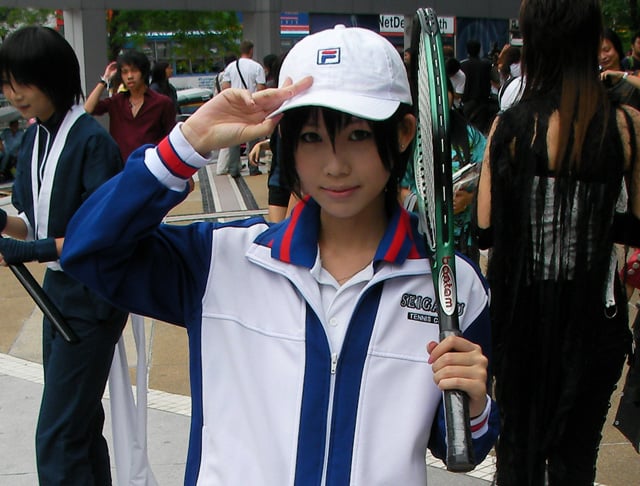
"Echizen Ryoma" from the anime "Prince of Tennis". You realise that this is actually a girl playing a guy's role. Cross-playing is also common in Japan.
"Chun-Li" from the game "Street Fighters". Many girls like to cosplay because of the 'cute' element that most female manga, anime and game characters show.
In Singapore, there is the Mid-of-year (MOY) and End-of-year (EOY) cosplaying event which are held between the Suntec Convention Halls and Singapore Expo Halls. Preparations will usually start two months before the event. I know that because it happens all the time at home. At around the month of June every year, I will start seeing 'weapons' and wigs laying around. It used to freak me out, but I got used to it after a few years.
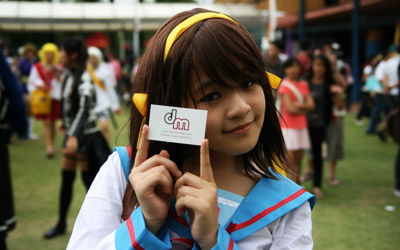
A Singaporean cosplaying "Suzumiya Haruhi" from the anime "The Melancholy of Suzumiya Haruhi" at Downtown East.
Although cosplaying is now very common and also a trend in Japan, it is still not an accepted culture by the more traditional-minded ones. However, many from outside of Japan will take it as a culture of Japan. The reason may be because that Japan is famous for producing anime, manga and video games, therefore many may think that it is only rightful to dress like characters from those. Another reason may be more "common-sensical" - cosplaying originates from Japan. Contradicting but true, there are always the black sheep in the society. I hope I am not confusing anyone.
You must be curious about the title. If there is such as thing as 'main-stream', that means...
Yes, there is also a 'sub-culture'. But we will talk about that in the next post.
When I say 'main-stream', I think about Kimono, respect and determination that the Japanese holds to every individual. When I see 'Japanese traditions', I think about tea ceremony, karate, judo and kendo.
The Japanese are civilised, strict, particular and any-other-good-adjectives-you-can-think-off group of people. They have very strict, everyday life, rules to live with. A single small mistake may be deemed as imperfection to the society. This may sound good to some (like me) but bad to others (I shall not name).
I am quite a lawful citizen, I think. Therefore, the strict rules that the Japanese live with is a positive motivation to me. My thought of these rules and regulations is that they are the reason for quality production of goods. It may also be the reason behind high quality of life that the citizens enjoy.
I find the that there are certain similarities in the Japanese and Chinese culture. This may be due to the early immigration activity where it is popular for the Chinese from mainland China to migrate to nearby countries, an example being Japan.
I sort of made that inference from the cultural activities of both nationalities. Calligraphy, tea ceremony and 'martial arts' are some examples of cultural activities shared by these two nations. I realised that the Kimono of Japan is also similar to that of Chinese costumes from the olden days.
A simple Japanese Kimono.
Chinese clothings from the olden times (i.e Ming Dynasty).
I think the obvious similarity in these costumes is that they are conservative, which reflects both cultures very well.
Now, remember I mentioned about 'martial arts' above? So why the punctuations? Well, I think I wouldn't really call the Japanese Karate, Kendo and Judo martial arts, but that's the closest I can get.
These cultural activities have become popular sports nowadays and is spread all over the world. These sports are now made official and is compete-able. However, in the olden times, these activities were used as spiritual practices and understanding of the body and mind of the individual, just like Chinese martial arts.
Karate competition. At the same time, do observe the formalities before the match starts.
Kendo is a sport where swords are used. In the modern times, bamboo made swords are used to replace the original ones so as to prevent life threatening injuries.
The words in the picture reads 'Kendo' in Japanese, but it can also be read as 'Jian Dao' in Mandarin, which holds the same meaning.
Judo styles. Judo is about using strength to counter speed. But at the same time, Judo is not all about strength. People who practices Judo uses the mind to anticipate moves, and with slow speed and strength from the whole body (not only one part of the body) counter the attack of the opponent.
*note: I am not trying to promote the card. I just thought this is quite and interesting video.
The above video shows some of the traditional performances of the Ainu people.
The Ainu people are said to be the only natives to Japan. This group of people generally populates Hokkaido regions and had brought their traditions and culture over to Russia. The Ainu people are nature-loving and believe in its power. The traditions and cultures of these people are still being passed down from generations to generations.
However, due to globalisation, the cultures of the Ainu people are getting diluted. Traditional Ainu-only marriage are also no longer feasible. The people are also spreading themselves out throughout Japan, and forgetting the way of life as part of nature as most are living in the cities now.
(This picture shows an Ainu boy and his spirit portrayed in an anime called Shaman King. Notice the patterns of the clothing are like symbols. The nature spirit shows that Ainu people are closely related to the nature.)
As early migrations are popular, there were many exchanges between Russia and Japan due to their geographical locations. As the Ainu people head over to Russia to settle down, many of Russia's indigenous groups travel down to settle at Japan too.
Both the Nivkh people and the Orok people originate from Russia and settle in the Northern parts of Japan (i.e Hokkaido) in the early days.. These indigenous groups brought along with them the tradition, culture and way of life to Japan. Until now, these groups still dominate the region. However, like the Ainu people, these groups have also lost some of their traditions and population as time goes by.
Not all indigenous groups live in the North. From the South, the Ryukyuan people brought their way of life and settled for Japan in the early days. This group populates Okinawa prefecture, and island South of Kyushu from the main island. Since this is a small group of people, their traditions can hardly be found in Okinawa. Many have moved on with the modern pace. There are many notable celebrities in Japan who are of Ryukyuan descent.
Singer Amuro Namie
Singer-Actress-Model Aragaki Yui
Actor-Model and former Singer Kaneshiro Takeshi and
I was never the kind to go for only Hollywood movies. A good movie is a good movie, regardless of where is it from or where will it go. Period. Well, for my case at least.
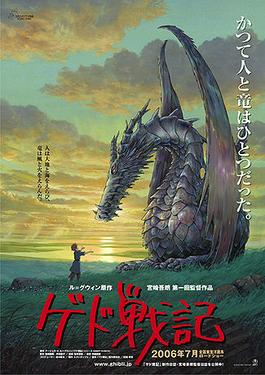
Since a tender age, I have always loved movies like My Neighbour Totoro and Laputa: Castle in the Sky. As I grow older, I found out that I am fond of watching Japanese animations. Spirited Away, Tales of Earthsea and Ponyo are all my favourites.
The person who allowed me to reminisce my childhood is none other than Miyazaki Hayao. He is the creator of many characters of every children's dream (including mine).
Following his footstep is his son, Miyazaki Goro, the director of Tales of Earthsea. Although the movie was not well received by audiences, it was nominated in 2007 for the Japan Academy Prize for Animation of the year. It was also through this movie that he was 'acknowledged' by his father.
Of course, Japanese movies are not all about animations. There are movies adapted from novels or mangas (Japanese comics) and also movies made for continuation of drama series are really popular now. The term for all these movies are usually called "live action".
Manga-turn-drama-turn-movie-turn-anime, Nodame Cantabile is one of the most famous in Japan and of course, my favourite story.
\
I guess the reason for it to be so famous is the comedy factor.
Does Squaresoft, Square Enix or Final Fantasy sounds familiar to you? If yes, good for you. If not, Uematsu Nobuo. Google that name. You will find that you have missed out the a talent for however long you have lived.
Uematsu Nobuo is a renown composer in Japan, famous for his works for the game series Final Fantasy by the game producing company previously known as Squaresoft, better known as Square Enix now. I would say that he goes for the contemporary style and his pieces can vary in the tension and feelings that they give to the audiences.
"At Zanarkand" by Uematsu Nobuo. One of my favourite piece.
I know classical music doesn't really match me, but I do like it a lot, honestly. Of course, I listen to pop and rock too, like any other teenagers out there.
Here are a few favourites of mine to share:
My favourite song, "運命の人" (the fated one) by EXILE, my favourite band!
"君に届け" by Flumpool. The singer for this band was my Japanese teacher's classmate in high school.
Since I promise that I won't be posting about festivals and events any more (or at least I try not to), I will be putting all the related information (web pages) under 'Links' at the sidebar.
Other related web pages (about Japan tourism, culture and society) will be there too, even if I am not posting anything about it or I am not using the web page as reference. So please look out for the link updates!
This is how much I love Japanese events and festivals. I promise this is the last post for festivals.
Yayoi Festival or Gota Matsuri is a festival in Tocihigi Prefecture that welcomes the arrival of spring. 12 towns will present their decorated floats along the streets of Nikko City on the 17th of April every year. This tradition dates back to the 8th century.
Sounds (and looks) familiar?
I think you are thinking about the Chingay Parade Festival in Singapore.
Every year, the Chingay Parade Festival will be held during the Chinese New Year festive season. It is suppose to welcome the arrival of spring with parade and floats too,but well, we all know that Singapore is summer all year round, so let's just take it as it is.
Unlike the Yayoi Festival in Japan, Chingay Parade Festival does not have a set amount of float presenters every year. However, the Japanese Association of Singapore is sure to be there every year to participate. This is how much the Japanese love festivals (just like me), they bring it to wherever they are.
As you can see, I am once again part of this event. I know it sounds like I am almost everywhere but, how can I ever miss a chance of wearing a Kimono? So yes, I am a participant of the Chingay Parade Festival 2010 as a Warabe Dancer in the Japanese Association of Singapore.
"Fun" is not exactly the word that I'd use to describe the experience. It was more than that, trust me.
Because of this event, I was able to make international friends as you can see in this picture to the left. Hint: I was the only Singaporean in it.
"Behind the scenes" of Chingay, we get to take pictures with whichever float we want.
There are definitely much more festivals than what I have mentioned so far in this blog (did I just say that the Japanese love festivals?), so I will put a link at the sidebar to direct to the Japan National Tourism Organisation Traditional Annual Events page. Enjoy!
I know I have not been updating everyday as promised. There is a reason to it, of course.
The annual Ship for South East Asian Youth Program (SSEAYP) is sponsored by the Japanese Government and supported by ASEAN countries, bringing more than 300 youths of different nationalities and ethnic groups together on board Fuji Maru.This is the 37th year for the SSEAYP, and I am very glad to be part of it.
From Wednesday, 1 December, to Friday, 3 December, I was hosting two Participating Youths (PY) from the Laos Contingent and Cambodia Contingent (therefore the absence of posts here). It was a unique experience for me and I get to know more about the two countries without having to travel there. I was also able to grasp more information about this event from my PYs.
The PYs from each ASEAN countries (28 from each country) will fly over to Japan for 10 days and stay at local homes for 1 day 2 nights. On the other days, they will be on board the Fuji Maru and participate in various discussion and activities with youths from different countries. On the 11th day, the Fuji Maru will embark and set sail for the designated ASEAN countries. This year, PYs get to stay at local homes of Thailand, Laos, Indonesia, Singapore and Vietnam for four days each, interacting and exchanging cultures with the locals every time. The whole program will last for about 40 days this year.
I think this program is really interesting as to how Japan collaborates with all the member countries of ASEAN and bring about such a unique cultural exchange hub. I really hope that I will be able to represent Singapore as a PY in 2012, when I graduate, and of course, I will definitely be hosting more PYs next year if there is a chance.
Me and my PY from Cambodia enjoying our ice-creams by the Singapore River.
My brother and a friend who is representing Singapore as a PY.
My PYs bringing us around in the Fuji Maru.
The Japanese Contingent
Captain of the ship
Streamer throwing session! This is the most exciting part and yet the most "heart-wrenching" part of the program.
Ever heard of the tradition in Japan where firecracker producing villages will compete against each other to see which village produce better firecrackers? Nagaoka is now a city located in Niigata Prefecture. It used to be just a town with many villages and is famous for producing firecrackers. Every year, different villages will compete to win the title of 'best firecracker producing village'. It is said that, during the competition, viewers or villagers will shout out the name of the village they support. The name with the loudest cheer will win the competition.
The tradition has now become a festival in Japan where not only villagers are able to see beautiful firecracker performance and vote for their favourite, but curious individuals from all over the world can join in the fun too.
One of the most interesting Japanese Culture is their festivals. I am saying it because I have experienced it before. Not the actual one in Japan, though I'd love to attend even just once.
Every year, the Japanese Association will hold a Natsu Matsuri (summer festival) at the Japanese Elementary School in Changi. Locals and the Japanese community will get a chance to eat, play and dance together. My friend and I are a loyal fan of that festival. Every year, we will loan a set of Yukata to wear for the festival and imagine ourselves in Japan. We will also join everyone in the Bon-Odori Dance to have a feel of traditional Japanese dances. We never fail to enjoy ourselves every year.
This little Japanese girl was really adorable! The mother was really kind and allowed me to take some pictures of her daughter.
Ringo Ame (Apple Sweet) is the most popular snack at the festival. It usually goes out of stock within 30 minutes of the festival.
About a month after the Natsu Matsuri, Waseda Shibuya High School Singapore will hold their annual Seiransai (School Festival) and allow both students and other locals to enjoy themselves with the games put up by the students from the school. There will also be traditional Japanese Cuisine done by students, their parents and teachers. It is also one of my 'must-go' event of the year.
Guests are allowed to try on their school uniforms and take photos. This is the uniform for Junior High students.
As promised, a post on the reasons why I choose Japan as my research topic.
Have you ever thought about why do you like to eat chocolate so much? Why you can't seem to take your eyes off that guy sitting at the other side of the class? Why your name is Chucky (you must really hate your parents for that)?
I have never really wondered why I like Japanese culture so much, until I was asked by some Japanese exchange student. I don't really have an answer to that, but I thought about living there and the feeling was quite comforting. Perhaps Singapore is just too 'sub-cultured'. By that, I meant the 'rojak culture', Singlish, Kiasu and stuff. Don't get me wrong, I do love my home country. I just find living in a place where the public transport being late is a valid reason for you to be late for work or school comforting. Try telling your boss or teacher "the bus was late" in Singapore. 90% of them will tell you to take the earlier bus next time and sort of blacklist you for that.
In Japan, the buses and trains are hardly late. If the bus or train is scheduled to be at a certain stop at 7 a.m, they will live up to their promise. I was told by my tour guide that the total amount of times for a bus or train to be late is an average of three times every year. Every time a train or bus cause a commuter to be late for work or school, the commuter can request for a letter to give it to their employer or teacher to be excused for being late. Try beating that.
That is just one of their culture that I am totally in love with. Others like being respectful and responsible adds up my love for the Japanese culture. I guess I am quite strict with traditions and laws.
One of the other reasons I chose Japan is that I have made myself some interesting friends when I participated in the Chingay Parade 2010 as a dancer in the Japanese Association of Singapore. There were five Japanese, a German and a Canadian who have to live in Singapore as their husbands' company had dispatched them over here for a rather permanent period. They have induced me with all of their own culture and I have indeed had a rare experience.
Four of the Japanese mothers lived in Chiba back in Japan and one of them is from Nagoya. I have heard many stories of their past and it sort of enticed me to want to know more. Therefore, I have decided that this is a great opportunity for me to get to know the Japanese better and at the same time spend more time with my new friends. Trust me, the information I get from them is so much more valuable than Wikipedia.
I will try to keep this blog updated everyday from now. "Try" being the active word in the sentence, since this is getting really exciting for me. I am taking it as a little adventure of mine now, with some stress in doing it though (since, I can't mention enough that, this is a school work). Let's just hope this does not look like 'nothing' to my tutors. I have tried to introduce some of the Japanese culture here and there even in these two random posts and hope I get my message across, because I am usually, really, bad at that.
Hello! This blog is part of my project assignment for one of the modules that I am currently taking in school now, namely Tourism, Culture and Society.
Honestly, I am still a little confused about what this module is about and how am I suppose to go about doing all the project and assignments (including this one). So I am just going to do it my way and hope it turns out well.
Basically, I am suppose to make this into some sort of a travel blog - something informative about the destination I choose to do on (some of you would probably have guessed the country already). I am to talk, comment and reflect about the culture and 'Disneyization' of the place. Wonder what's 'Disneyization' all about? I will talk about it more in some other posts.
Since we are suppose to do this assignment on a blog, I am just going to really blog-it-out. The tone that I will be using is semi-casual (if there is such a thing) and I will try (real hard) not to make any grammar or language-related mistakes. After all, this is a project... assignment... school-stuff... well, you get the idea. Some of you may already have an idea what am I talking about (semi-casual) after reading this post. To put it simply, this will be some sort of a little girl's diary, only with an aim - to pass this module.
Anyway, are you wondering what is the title of this blog all about? For those who have guessed it, great job. For those who didn't get it, I will be doing on the country Japan, particularly on Chiba Prefecture. I have been there once, last year, and it was an awesome experience. Itato has the meaning of 'was' in Japanese. I am trying to say that this blog is about my trip to Japan "was" -fill in the blank-.
"I" or "い" means "行った", which means "been (there)".
"T" stands for "Tabetta" or "食べた", which means "ate".
"A" stands for "Asonda" or "遊んだ", which means "played".
"T" stands for "Tanoshikatta" or "楽しかった", which means "enjoyed/had fun"
"O" stands for "Oboeteitta" or "おぼえていた", which means "remembered"
If you are wondering, my answer is no, I am not a pro in Japanese Language. I have only passed my Japanese Language Proficiency Test Level 4/Number 5, something to be proud off but nothing to boast about - I know of one girl in my class who is much better in it than me.
Anyway, this post is getting longer, or too long perhaps? I guess I am quite excited about this assignment after all. Reason? Next post...





.jpg)
.jpg)


